In short. Using AI responsibly in application review comes down to five rules. People make every decision. The AI reads each application in full against your published rubric and shows the evidence for what it says. Any claim from outside the application comes with sources you can open and check. Names and contact details never go to the AI. And applicants are told, in plain words, that AI is used and what it is used for. Anything short of that turns a time-saving tool into an unaccountable one.
Programme offices are under real pressure. A call that draws 600 applications cannot be read three times each by a volunteer panel in a fortnight, and AI help is tempting. The risk is not that the tool is useless; it is that it is trusted for the wrong job. This article sets out what a responsible setup looks like, in terms a programme officer can put in a policy and an applicant can understand.
Decide What the AI Is For
Start by separating two jobs.
- Reading and summarising. Producing a structured account of what an application says, scored against the rubric's criteria, with the passages that justify each score.
- Deciding. Choosing who is shortlisted, funded, admitted or rejected.
Only the first belongs to the AI. The decision belongs to named people who can be asked why. This is a design principle, not a courtesy: Indian and international data protection thinking, and emerging AI rules, converge on keeping a human accountable for decisions that significantly affect a person. A scholarship refusal or a rejected grant qualifies.
Write the allowed uses in one paragraph of your reviewer guidance. A workable version: "The AI may summarise an application, propose criterion scores with evidence, flag missing information and answer questions about the applications in this programme. It may not rank applicants to the exclusion of reviewers, make an accept or decline decision, or message applicants."
Make It Read Against the Rubric
A generic "is this a good application?" prompt produces fluent opinion. A rubric-anchored read produces something a committee can check. The difference is the same one that separates a scored rubric from an impression.
What to require of any AI reading:
- Every application is read in full, not a truncated first page. Ask how long inputs are handled, because silent truncation is a common failure.
- Scores are per criterion, using your descriptors, not an overall grade.
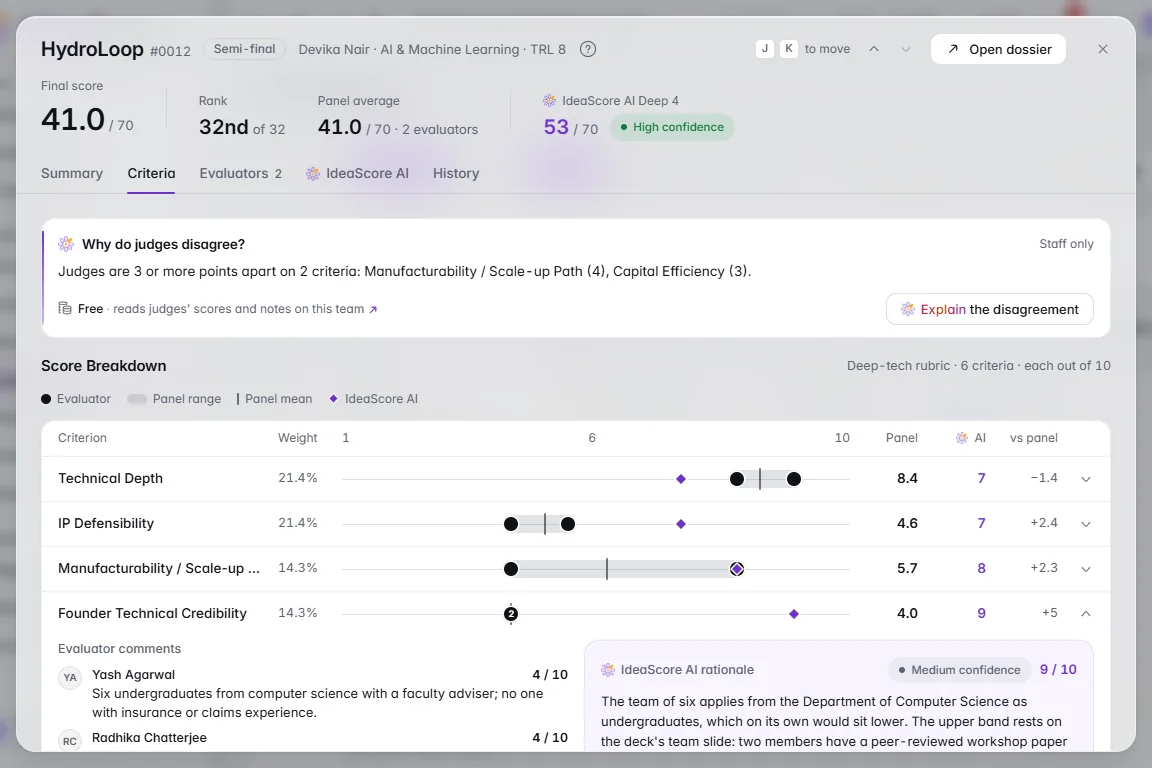
- Each score cites evidence, quoting or pointing to the passage in the application that supports it.
- Gaps are reported as gaps. If the application does not mention a competitor, the output should say so, rather than inventing a reassuring sentence.
- The reviewer can disagree. The AI score is an input shown to the evaluator, who enters their own.
Test this before relying on it. Take ten applications your panel has already scored, run the AI over them, and compare. You are not looking for identical numbers. You are looking for whether its reasons make sense and whether it fails in a direction you can predict, such as favouring longer answers.
Sources You Can Check
Some questions go beyond the application: is this market figure plausible, does this competitor exist, is this patent real. If an AI tool answers these from memory, you cannot tell good answers from confident ones. A responsible tool does one of two things: it stays inside the application and says what it cannot verify, or it goes out to the open web and lists the pages it used so a person can open them.
Apply a simple standard. If a claim could change a score, a reviewer must be able to click through to where it came from. A summary that says "market size is overstated" without a source is an opinion; with two linked pages it is a lead worth following. Treat unsourced external claims as unverified, and train reviewers to do the same.
Keep Names and Contact Details Out
The AI does not need to know who the applicant is to judge the work. Sending names, emails and phone numbers to an AI service adds privacy risk and bias risk for no benefit.
A practical policy:
- Names and contact details are not sent with the application text.
- Sensitive answers are excluded entirely: income, category, disability, health.
- State what is sent and what is stored, and for how long, and whether customer data is used to train anything. Applicants and your own legal team will ask.
- Be honest about processing location. If text is processed outside your country, say so in your privacy notice.
This matches the data protection principle of minimisation: use the least personal data that does the job. It also supports blind review, since the AI cannot be swayed by what it never receives.
Beware Signals Dressed as Verdicts
Some tools flag applications as "likely AI-written" or "possible duplicate". These are signals. They are wrong often enough that acting on them alone would harm honest applicants, particularly those writing in a second language, whose prose can look unusual to a detector. Use a similarity flag to prompt a human look at the application, compare it with the earlier one, and decide. Never decline an application because a tool said it looked machine-written.
Tell Applicants
Transparency is cheap and protective. Put a short statement in the call document and the application form:
- That AI assists reviewers by summarising applications and proposing rubric scores with evidence.
- That people make every decision.
- What data goes to the AI, and what does not.
- How an applicant can ask a question or raise a concern, and who answers.
Applicants rarely object to assistance they understand. They object to discovering it afterwards. If you collect personal data in India, this statement can sit alongside your privacy notice; our piece on the DPDP Act for programme offices covers that notice.
Audit and Review
- Log every AI run: which applications, which version of the tool, when, and who triggered it.
- Sample for quality. Each round, pull a handful of AI outputs at random and have a senior reviewer check the evidence.
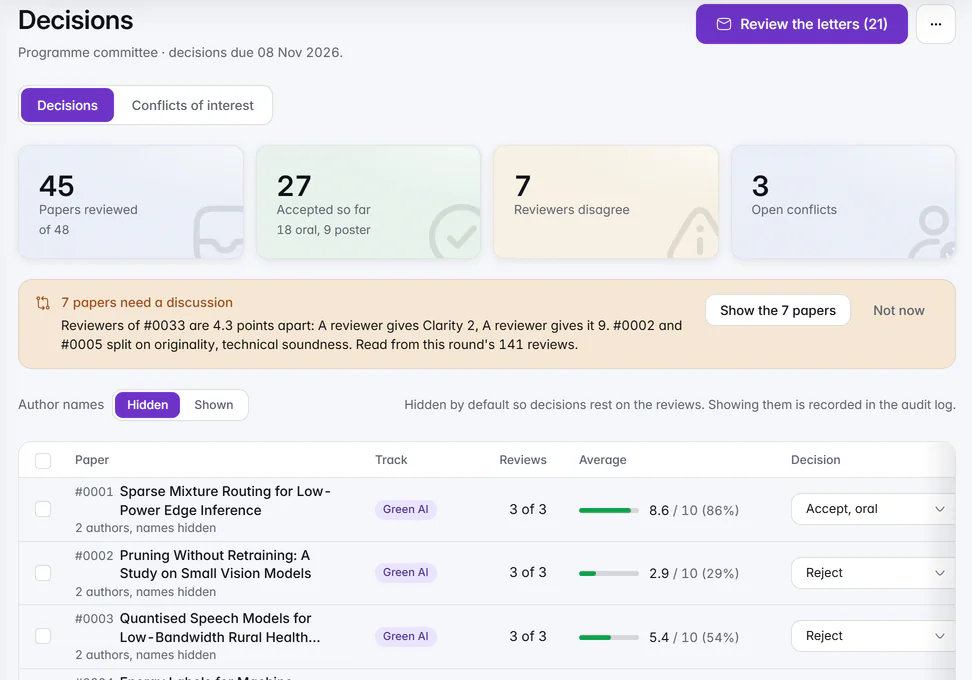
- Compare outcomes. After decisions, look at whether AI scores and human scores diverged, and where. Consistent divergence on one type of application is a finding.
- Keep a human override path and record why overrides happen.
- Re-check when the tool changes. A changed version is a different instrument; run your ten-application test again.
How IdeaScore AI Fits
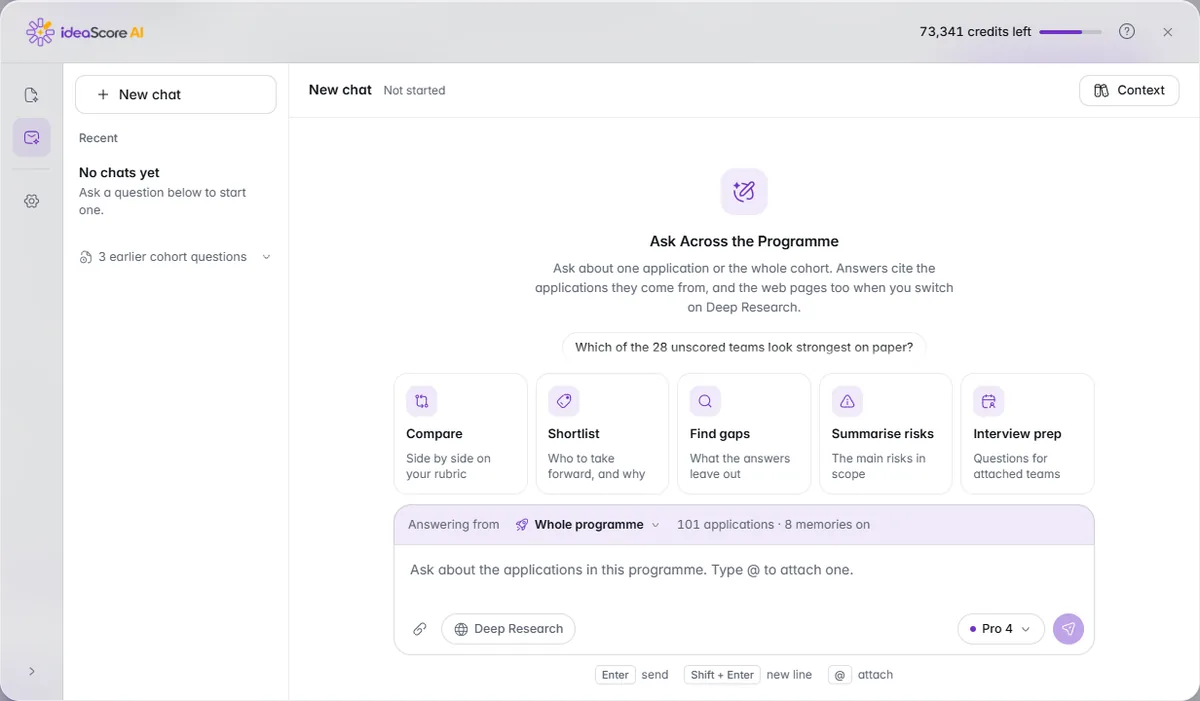
IdeaScore AI is built around these rules. It reads each application in full against your rubric and shows the evidence behind every score; the reviewer enters their own score and the decision stays with people. Names and contact details of the people in your programme are never sent to it, and sensitive answers do not reach its summaries. Deep Research also searches the web as well as your programme, and lists the pages it used, so the reviewer can check them; it adds 8 credits on Pro and Deep, and you see the cost before you send. You choose among Swift, Pro and Deep models in a simple picker, and your usage and credits are visible at a glance. It also offers reviewer signals such as similar answers and writing pattern, described as signals and not verdicts.
Your own policy still matters most. The product can make a responsible setup easier to run, but the allowed uses, the applicant notice and the sampling are your decisions.
A Responsible-Use Checklist
Used this way, AI shortens the reading and leaves the judgement where it belongs. The panel gets more time for the applications that are close, which is where human judgement is most valuable.