In short. A CSR grant-making cycle in India has five parts: proposals from implementing partners, each mapped to a Schedule VII area; due diligence on the partner; a committee decision; releases and utilisation tracked by financial year; and impact reporting. The discipline that matters most is a clean record at each step, so that when the financial year closes, every rupee approved, released and spent can be traced to a project, a decision and a date. This is general guidance, not legal or tax advice, so confirm the specifics with your company secretary or adviser.
Corporate social responsibility teams often run grant-making from a mix of emailed proposals, a spreadsheet of approvals and a folder of utilisation certificates. It works for a dozen projects. At forty, someone asks which education projects were funded this year, how much of the budget is still releasable, and whether the amount spent matches what the board was told, and the answer takes three days.
The Legal Frame in Brief
Section 135 of the Companies Act, 2013 requires companies above certain thresholds of net worth, turnover or net profit to spend a share of their average net profit of the preceding three financial years on CSR. The rate usually quoted is 2 per cent. The activities that count are listed in Schedule VII, which covers areas such as hunger, poverty and health care, education and skills, gender equality, environmental sustainability, heritage and culture, rural development, and disaster management, among others.
Three practical consequences follow for the person running the programme, whatever the exact wording of the latest rules:
- Every project must sit under a Schedule VII heading. If a proposal cannot be mapped, it is not a CSR project, however worthwhile.
- Money is tracked by financial year. An obligation, an approval and an unspent balance all belong to a year, and the treatment of unspent amounts depends on whether a project is ongoing.
- Implementing partners have their own compliance. Registration of the partner entity, its track record and its reporting are part of the funder's checks.
Treat the above as orientation only. Rules and thresholds change, and the board's CSR policy is the document your committee works from.
Step 1: Receive Partner Proposals Against a Fixed Template
Ask every partner for the same information so that proposals can be compared. A usable template covers:
Ask the partner to name the Schedule VII area, then have your own team confirm it. Disagreements between the two are useful: they show where a project is stretching the category.
Step 2: Map and Screen for Fit
Before due diligence, screen quickly against the policy: is the area one the company has chosen as a focus, is the location within the geographies it supports, is the amount within the range it funds, and does the project avoid anything the policy excludes? A one-page fit summary saves the committee from reading forty full proposals to find twelve worth discussing.
Step 3: Due Diligence
Due diligence on an implementing partner is a checklist, completed and filed for each one:
- Registration documents and the legal status of the entity.
- Audited accounts for the last two or three years and the latest annual report.
- Governance: board or trustees, conflicts, how decisions are made.
- Past projects and references from earlier funders.
- Capacity: staff, field presence and ability to absorb the amount sought.
- A site visit or a call for projects above a threshold the committee sets.
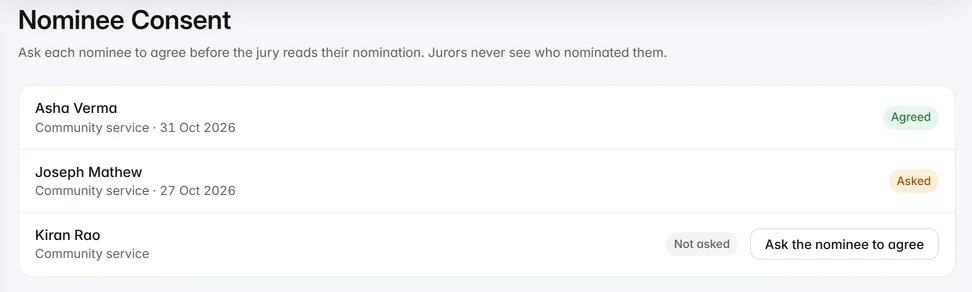
- Conflicts on the funder side, for example a board member linked to the partner.
Record the outcome as findings with a clear status for each item, not as a general impression. When a committee member asks later why a partner was approved, the file should answer.
Step 4: The Committee Decision
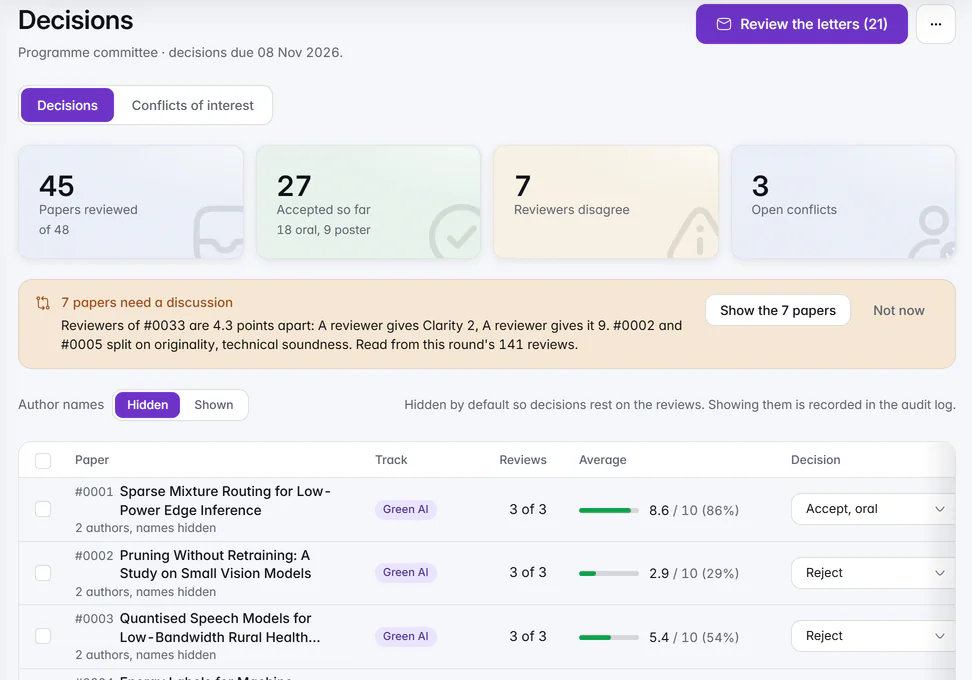
The CSR committee needs a short, consistent pack for each proposal: the fit summary, the due diligence findings, the budget and the recommended action. A good meeting produces one of three outcomes for each proposal, which are approve (with an amount and conditions), defer (with a named question), or decline (with a reason that can be shared with the partner). Minutes should capture the amount approved, the tranches, and any dissent.
Two habits protect the programme. First, approve for the financial year in which money will be released, so the approval and the utilisation line up. Second, keep the reason for a decline in a form you can send, since partners value a clear answer, and it protects the company from the suspicion that proposals vanish.
Step 5: Releases and Utilisation by Financial Year
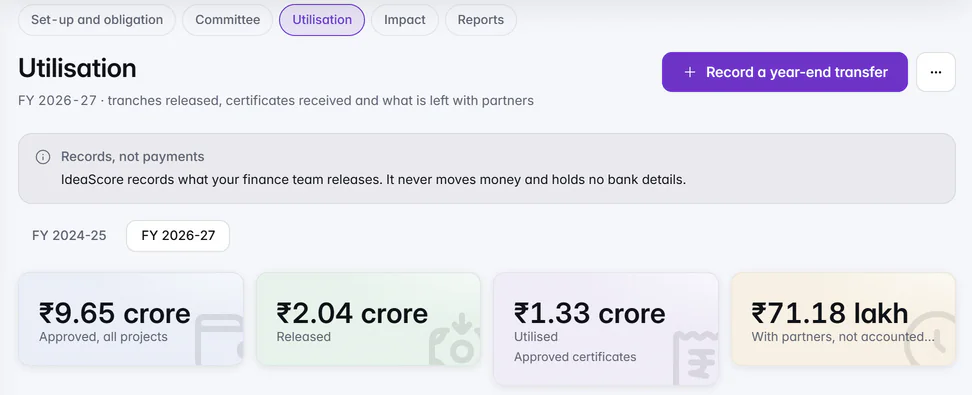
Approval is not release. Between the two sit tranches, each tied to a milestone: an advance at signing, a second payment after a progress report, a last payment against a completion report. Track three numbers for every project and every year:
- Approved: what the committee sanctioned.
- Released: what has actually gone to the partner.
- Utilised: what the partner reports as spent, supported by a utilisation certificate.
The gap between released and utilised is money sitting with the partner. The gap between approved and released is what is still releasable. Both should be visible at any time without anyone assembling them by hand.
A year-end lock is worth having. Once the financial year has been reconciled and the figures reported to the board, the year's numbers should stop changing. Corrections after that go in as dated adjustments in the next year, with a note, rather than as silent edits to history. This is what makes a year's figures something an auditor can rely on.
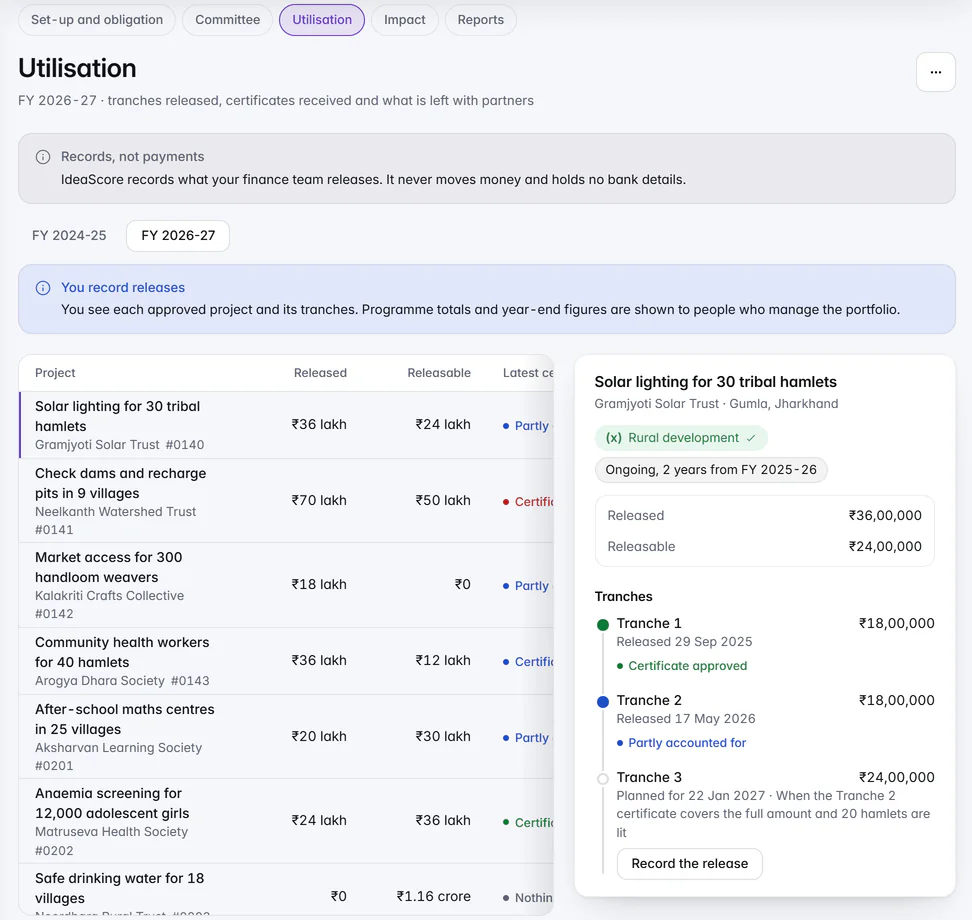
Finance teams have a different need from programme officers. The finance person needs to record that a tranche of a given amount was released on a given date against a given project, and to see how much of that project is still releasable. They do not need to see the programme's totals or the committee's deliberations, and often should not.
Step 6: Impact Reporting
Impact reporting asks whether the outcomes promised in the proposal happened. Keep it proportionate:
- Quarterly or half-yearly progress notes from partners against the outcomes in the proposal.
- A completion report with final figures, photographs or evidence the partner can share, and a short account of what changed.
- Independent assessment for larger projects, where the rules or your policy call for it. Check the current thresholds with your adviser.
- A partner report back to each partner, so the relationship does not run in one direction only.
- An annual summary for the board, by Schedule VII area, by geography and by financial year.
Compare what was promised with what was achieved, and write the difference down. Funders who report only successes lose the ability to learn which kinds of projects work.
A Year-End Checklist
- Every approved project has a Schedule VII area recorded.
- Every release has an amount, a date and a tranche against a project.
- Utilisation certificates are in hand for what partners report as spent.
- Unspent amounts are identified by project and treated as the rules require.
- The year's figures are reconciled with finance and then locked.
- Impact notes for the year are in, with gaps listed.
- The board summary matches the underlying records.
Where IdeaScore Fits
IdeaScore has a home for CSR funding of its own. Partner proposals come in with Schedule VII areas, a fit card and a due diligence record, and a committee board holds the decision. Utilisation is tracked by financial year, with a year-end lock, and impact and partner reports are produced from the same records.
Finance members have their own view: they record releases and see each project's released and releasable amounts, without programme totals. One point is worth stating plainly. IdeaScore records releases; it never moves money. The payment itself stays with your bank and your finance process, and the record simply shows what was paid, when and against which project.
Questions Programme Officers Ask
Can a project fall under more than one Schedule VII heading? Record the primary heading the company reports under, and note any secondary one in the proposal.
How do we handle a partner that is late with a utilisation certificate? Hold the next tranche, write to the partner with a date, and record the delay.
Who should see the budget totals? Committee members and programme managers need them. Finance staff recording releases need the project level, and partners need only their own project.
What should a decline letter say? The decision, the main reason in plain words, and whether the partner may apply again in the next cycle.